
CEFR Explained: What the A1–C2 English Levels Mean and How to Prove Yours
Short answer
The CEFR (Common European Framework of Reference for Languages) is a six-level scale, from A1 to C2, that the Council of Europe created to describe what someone can do in a language rather than to score a single exam. It groups ability into three bands, basic (A1 to A2), independent (B1 to B2) and proficient (C1 to C2), each defined by practical can-do statements. Employers, universities and course providers use it as a shared vocabulary for level, though what any one of them accepts as proof is decided by that organisation. To document your own CEFR level, you take an assessment that reports it and, ideally, issues a certificate a reader can verify.
Last reviewed: July 2026
What is the CEFR?
The CEFR, the Common European Framework of Reference for Languages, is a scale for describing language ability that the Council of Europe published in 2001. It grew out of decades of work on how to talk about what learners can actually do, and its purpose was practical: to give schools, examiners, employers and learners across different countries one shared vocabulary for level, in place of a patchwork of national grades that meant little to each other.
Two features define it. First, it is descriptive rather than tied to any one exam: it says what a B1 user can typically do, not what mark a particular paper awards. Second, it is framed in can-do statements, positive descriptions of real tasks a person can carry out, such as following the main points of a clear talk or writing a straightforward report. Although the framework began in Europe, it is now referenced far beyond it, and CEFR levels turn up on course materials, job adverts and certificates around the world.
It is worth being clear about what the CEFR is not. It is not a test, and it does not belong to any single exam board; it is a reference, a common yardstick that different tests, textbooks and courses can line themselves up against. That is why you meet the same six labels on a language-school syllabus, a job advert and a certificate, even though none of those is the CEFR itself. Understanding that distinction is the key to using it well and to reading the claims that others make about it.
The six levels at a glance
The framework splits ability into six levels across those three bands. The table below sums up what each level tends to mean in everyday terms and where it usually sits in study or work. It is a general orientation to help you place yourself honestly, not a statement of any institution's requirement.
| CEFR level | What a person can typically do | Where it tends to sit |
|---|---|---|
| A1 (Beginner) | Understand and use basic words and set phrases for immediate needs, and interact slowly with a patient speaker. | The starting point of formal study; rarely enough on its own for work or academic use. |
| A2 (Elementary) | Follow short, simple information and hold basic exchanges about familiar, everyday matters. | Suits travel and simple service tasks; below most academic entry points. |
| B1 (Intermediate) | Cope with routine situations, follow the main points of clear standard input, and produce simple connected text. | The point where a learner becomes an independent user; enough for some foundation and pathway steps. |
| B2 (Upper-Intermediate) | Follow concrete and abstract discussion, interact with reasonable fluency, and write clear, detailed text on a range of topics. | A common benchmark for many undergraduate courses and mixed-language workplaces. |
| C1 (Advanced) | Use English flexibly for complex, demanding purposes and grasp implicit meaning in long, involved texts. | Expected by many postgraduate courses and roles built on persuasion or writing. |
| C2 (Proficient) | Understand almost everything read or heard and express fine shades of meaning precisely, at near-native command. | Rarely set as a minimum; it marks the top of the scale. |
Each level has a page of its own if you want the detail: A1, A2, B1, B2, C1 and C2. For all six side by side, see our CEFR language levels (A1–C2) guide.
How are CEFR levels assessed?
Because the CEFR is built on can-do statements, assessing a level means judging which of those statements a person can reliably perform, not converting a raw mark into a grade. A full assessment samples the four skills the framework describes, reading, listening, speaking and writing, and places the result on the A1 to C2 scale. In practice, different tests cover different combinations of those skills, so it is always fair to ask a certificate which skills sit behind the level it reports. A level backed by all four skills and a level based on reading and listening are both valid, but they describe different things, and an honest certificate is upfront about which it is.
The International English Test, for example, measures reading and listening. Its certificate therefore evidences how well you understand written and spoken English, the receptive side of the framework, and it should be read in that spirit rather than as proof of speaking or writing. Where a course or employer needs to see production as well, a separate four-skill assessment is the honest answer, and a dedicated English writing test covers the written half on its own. If you simply want to place yourself on the scale, you can find your CEFR level this way and get a documented result in minutes.
Where is the CEFR actually used?
On a CV, a CEFR level gives a recruiter a figure they can compare across candidates, which is why it reads better than a vague word like fluent. The same logic runs through job applications, where an employer may want to confirm the stated level rather than take it on trust.
In education, many foundation, pathway and language-course providers describe their entry levels in CEFR terms, so it is a practical reference point for university applications, even though degree admission itself usually turns on a specific named test that the institution requires.
In immigration, CEFR levels sometimes appear in the wording of national frameworks, but the decisive evidence for a formal route is almost always a designated test that the authority names and secures itself. A general CEFR certificate can describe a level; it does not by itself satisfy a designated-test requirement, so anyone weighing it for immigration or visa applications should confirm the exact rule with the official authority first.
How do you prove your CEFR level?
You prove a CEFR level by taking an assessment that reports one and produces evidence a third party can check. A verifiable certificate does two jobs at once: it states the level on a shared scale, and it lets the reader confirm the document is genuine rather than trusting a screenshot. The International English Test issues this kind of certificate: it reports a CEFR level from A1 to C2, and each one carries a unique ID and a QR code that resolve to an online verification page.
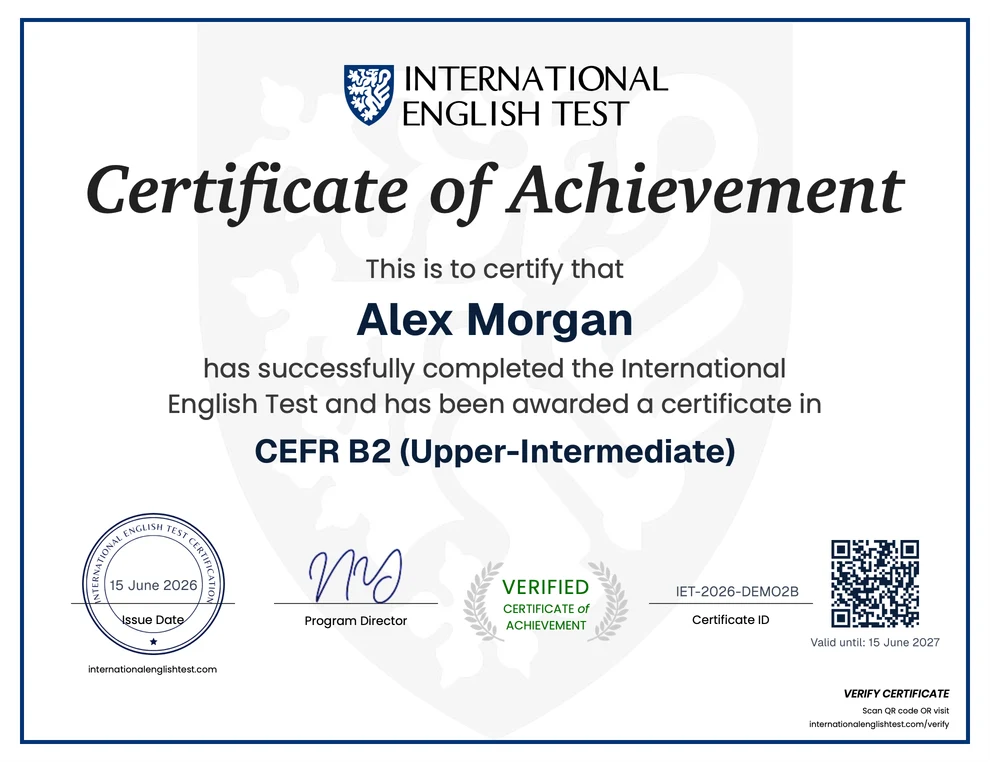
The sample above shows a B2 result. Because the level sits on the CEFR scale, it means the same thing to a reader in any country, and because it can be verified, it stands up to the checks a hiring or admissions process tends to run. It is the combination that does the work: a shared level a reader already understands, plus a way to confirm the document behind it is real. This particular certificate reflects reading and listening, so it is best presented as evidence of comprehension at the stated level.
How does the CEFR compare with IELTS, TOEFL and other scales?
You will often see charts that line CEFR levels up against IELTS bands or TOEFL scores, and it is worth understanding why those charts deserve caution. Each scale was designed for its own purpose and measures a different mix of skills under different conditions, so a CEFR level and a test band are not interchangeable currencies, and a rough correspondence is not an equivalence.
The practical rule is simple. Where an organisation states its requirement in a particular scale, that scale is the one that counts, and only the body that owns the requirement can say what satisfies it. Use the CEFR for what it does well, a clear and shared description of level, and take whatever named test a specific institution demands when it demands one.
Frequently asked questions
What does CEFR stand for?
CEFR stands for the Common European Framework of Reference for Languages. It is a scale published by the Council of Europe that describes language ability in six levels, from A1 at the start to C2 at the top, using plain descriptions of what a learner can do.
What does B2 English mean?
B2 is the fourth CEFR level, labelled upper-intermediate. A B2 user can follow the main ideas of complex and abstract discussion, interact with reasonable fluency, and write clear, detailed text, while still missing some of the nuance of the advanced levels. It is a common reference point for study and for mixed-language workplaces.
How long does it take to move up a CEFR level?
There is no fixed figure, because it depends on your starting point, how much you study and how much you use English day to day. As a rough guide often cited by course providers, moving up one level can take a few hundred hours of focused learning, with the higher levels generally taking longer than the lower ones.
Is the CEFR recognised?
The CEFR is widely used as a common vocabulary for language level by schools, publishers, employers and examination bodies in many countries. Being a recognised framework is not the same as any particular certificate being accepted for a particular purpose: whether a given document meets a requirement is always decided by the organisation that sets that requirement.
What is the difference between CEFR and IELTS?
The CEFR is a descriptive scale of language level, while IELTS is a specific test that produces a band score. A test can report its results on, or alongside, the CEFR scale, but the two are not the same kind of thing, and a rough mapping between an IELTS band and a CEFR level is orientation rather than an exchange rate. Where a requirement names one of them, that is the one to follow.
Test your English level today
Take the International English Test online and get a CEFR-aligned certificate with secure online verification.