
English Certificate for University Applications
Short answer
For degree-level admission, most universities require a specific English test that they name themselves, most commonly IELTS or TOEFL, and a general online English certificate is not a substitute for it. A CEFR certificate is useful for foundation and pathway programmes, language schools, placement and self-assessment, but it does not replace a required IELTS or TOEFL score where the institution demands one.
Last reviewed: July 2026
How do universities express language requirements?
Universities express English requirements as a named test plus a minimum score, often with per-section minimums. A typical requirement reads like “IELTS 6.5 overall, no band below 6.0” or a TOEFL iBT equivalent, and many list a small set of accepted tests rather than an open standard.
Because the requirement is tied to a named test and its scoring, the only authoritative source for any programme is that university's own published admissions page. Anything else, including the mapping below, is a guide for orientation rather than a requirement you can apply against.
How do CEFR levels map to common test bands?
The table below shows how CEFR levels line up, indicatively, with commonly cited bands on other tests. It is provided only to help you orient yourself; the numbers are approximate correspondences, and only the university's own published requirement is authoritative for a given programme. Do not use this table to decide that a CEFR certificate satisfies a requirement stated in IELTS or TOEFL terms, because it does not.
| CEFR level | Indicative IELTS band | Indicative TOEFL iBT range |
|---|---|---|
| B1 (Intermediate) | around 4.0–5.0 | around 42–71 |
| B2 (Upper-Intermediate) | around 5.5–6.5 | around 72–94 |
| C1 (Advanced) | around 7.0–8.0 | around 95–120 |
| C2 (Proficient) | around 8.5–9.0 | top of the range |
These correspondences are widely published and approximate. A university may set its own mapping, and its figure is the one that counts.
Where is a CEFR certificate useful in an application?
A CEFR certificate is genuinely useful in the parts of a university journey that do not require a named admissions test. These include foundation and pathway programmes that assess or place students on entry, language schools and pre-sessional courses, exchange and short-programme applications that ask for general evidence of level, internal placement into the right class once enrolled, and self-assessment before you commit time and money to a formal exam.
In these contexts, a certificate that reports a clear CEFR level and can be verified is a practical, low-cost piece of evidence. It is honest to use it there, and dishonest to present it as a degree-admission test where one is required.
What should you check before relying on any certificate?
Before relying on any English certificate for a university application, check the programme's own admissions page for three things: which tests it names, the minimum overall and per-section scores, and the accepted date range. If the page names IELTS, TOEFL or another specific test, treat that as a hard requirement and obtain the named test. If it accepts general CEFR evidence for a pathway, foundation or placement step, a CEFR certificate can serve that step, but verify the case that applies to you before you apply.
How do you get a CEFR certificate for your university application?
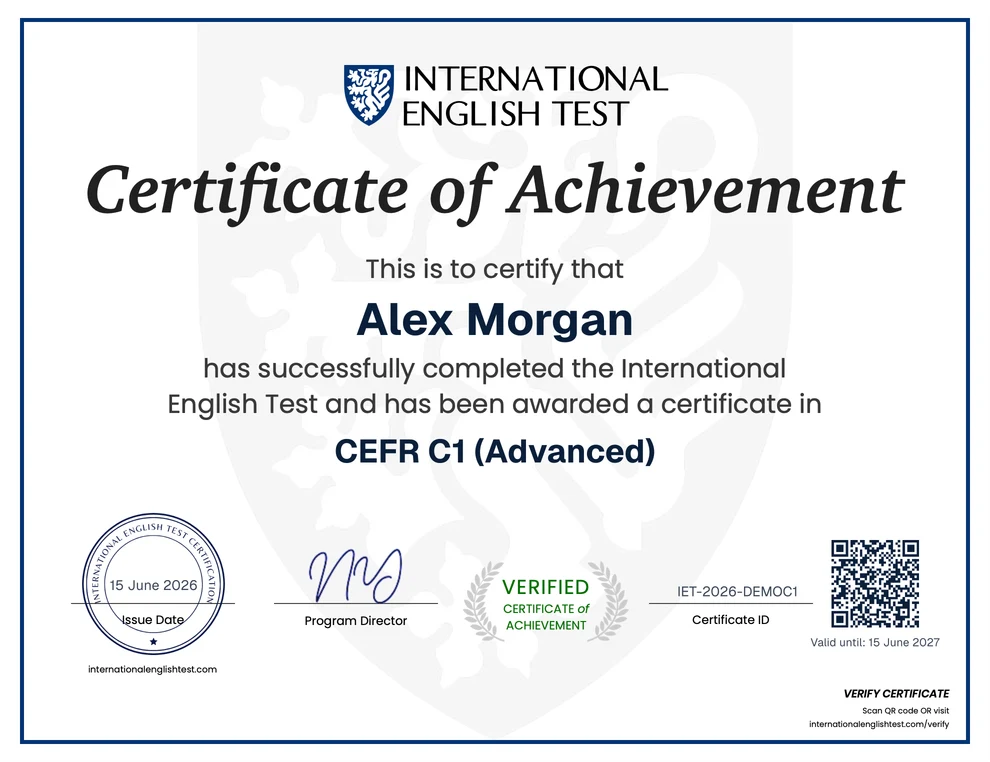
Where a CEFR certificate fits the step you are at, International English Test lets you establish a documented level before you commit to an expensive named exam. It is an online assessment reporting a CEFR level (A1–C2) with a verifiable certificate, run in any browser without an appointment and returned within minutes; each one carries a unique ID and QR code that an admissions or placement officer can check on a public page. The assessment covers reading and listening, so it documents comprehension and does not certify speaking or writing, which some pathway and pre-sessional courses assess on their own. International English Test is an ALTE Associate Member, a description of the organisation rather than a statement that any university accepts the certificate for admission. Pricing starts from £12.99. Using it to confirm you sit at B2 or C1 before booking IELTS or TOEFL is one of its most sensible uses, though it does not replace a named admissions test where a programme demands one.
Frequently asked questions
Can I use a CEFR certificate instead of IELTS or TOEFL for university?
For programmes that name IELTS or TOEFL, a general CEFR certificate is not a substitute; you must take the named test. A CEFR certificate is suited to pathway, foundation, placement and self-assessment steps that accept general evidence of level.
What English level do universities usually ask for?
Many undergraduate and postgraduate programmes ask for a level around B2 or C1, often stated as a specific IELTS or TOEFL score rather than a CEFR level. The programme's own published requirement is the one to follow.
Is a CEFR certificate useless for university applications?
No. A CEFR certificate is useful for foundation and pathway entry, language schools, placement and self-assessment. It is not a replacement for a named admissions test where the university requires one.
How do I know which test my university requires?
Check the specific programme's admissions page, which lists the tests it accepts and the minimum scores. If you are unsure, contact the university's admissions office; a third-party comparison is not authoritative.
Does an English certificate say a university accepts it?
No. A certificate records a CEFR level and lets anyone verify it. Whether it meets a programme's requirement is decided by the university, not stated by the certificate.
What does “receptive skills” mean on this certificate?
Receptive skills are reading and listening. The certificate reflects how well you understand written and spoken English and does not by itself certify speaking or writing, which some programmes assess separately.
Should I take a CEFR test before booking IELTS or TOEFL?
Taking a CEFR test first is a low-cost way to estimate your level before committing to an expensive named exam. It helps you decide whether you are ready, but it does not replace the named exam the university requires.
What if a university states its requirement as a CEFR level instead of an IELTS score?
Some institutions do express requirements as a CEFR level, particularly for pathway, foundation or placement steps. Even then, check whether the institution names which tests it accepts as evidence of that level, because stating a CEFR level and accepting a particular certificate as proof of it are two separate things.
Test your English level today
Take the International English Test online and get a CEFR-aligned certificate with secure online verification.