
English Certificate for Your CV
Short answer
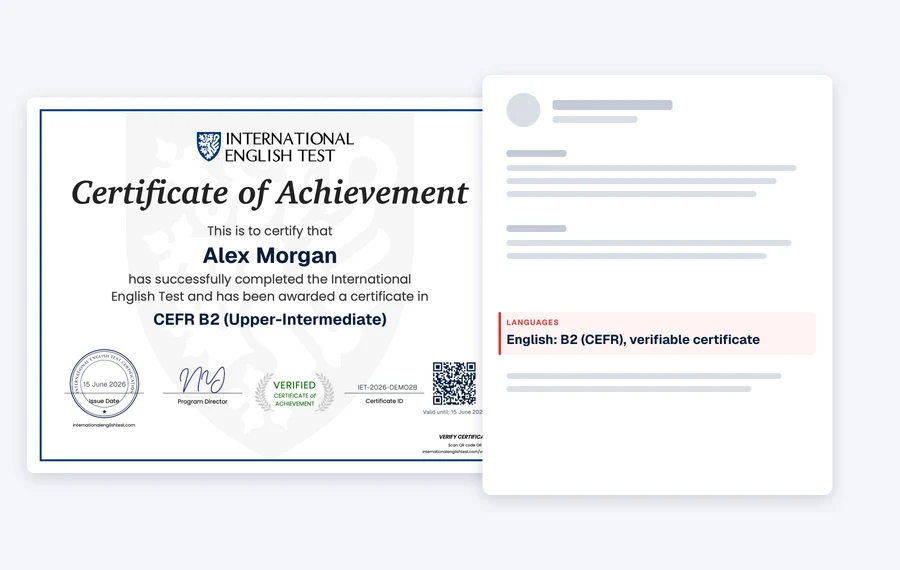
On a CV, state your English ability as a CEFR level (A1–C2) and, where possible, attach a verifiable certificate. A line such as “English: C1 (CEFR), verifiable certificate available” reads as a fact a reader can check. A CEFR level is a shared standard that means the same thing to any reader, while a self-assessed word like “fluent” is not a standard and cannot be checked.
Last reviewed: July 2026
Why does “fluent” tell a recruiter nothing?
“Fluent” is not a measurement, so it tells a recruiter nothing they can act on. The word means different things to different people: one candidate uses it for holiday conversation, another for leading meetings in a second language. A recruiter reading a stack of CVs cannot tell which one you mean, and cannot compare two candidates who both wrote it.
A CEFR level removes that ambiguity because every level has a defined, published meaning. Words like “native”, “bilingual” and “mother tongue” have the same problem when they are not strictly true: they are easy to write and impossible to verify from the page.
Where does the language line belong on a CV?
The language line belongs in a short, scannable “Languages” or “Skills” section, near your qualifications rather than buried in a job description. State each language once, with its CEFR level beside it, on a single line. Keep it consistent: if you give a CEFR level for one language, give one for all of them. A reader should be able to find your English level without hunting for it.
What do CEFR levels mean at work?
The Common European Framework of Reference for Languages (CEFR) is the six-level scale (A1, A2, B1, B2, C1, C2) used across Europe and widely beyond it to describe language ability. The table below describes, in plain work terms, what each level typically corresponds to. It is a guide to help you choose an honest level, not a claim about any employer's requirement.
| CEFR level | What it typically means in a work setting |
|---|---|
| A2 (Elementary) | Handles simple, routine exchanges such as short emails, basic instructions and familiar tasks, with frequent support. |
| B1 (Intermediate) | Manages everyday work communication on familiar topics, and deals with routine calls and messages, with effort on complex points. |
| B2 (Upper-Intermediate) | Works effectively in most professional situations: joins meetings, writes clear standard correspondence, follows detailed material in the field. |
| C1 (Advanced) | Operates comfortably in demanding professional settings, handling nuance, negotiation and long or implicit texts with ease. |
| C2 (Proficient) | Uses English with near-effortless precision across virtually any professional task, including subtle and specialised material. |
Which level should you claim?
Claim the level you can demonstrate on your worst day, not your best. Employers increasingly ask candidates to show English in the process itself, whether through an interview, a written exercise or a call, so an inflated level tends to surface quickly and costs more credibility than an honest lower one earns. If you are unsure whether you sit at B2 or C1, taking a standardised test settles it and gives you a figure you can defend.
How do you get a CEFR certificate for your CV?
International English Test is an online assessment that reports a CEFR level (A1–C2) and issues a verifiable certificate, so the language line on your CV stops being a claim and becomes something a recruiter can confirm. You take it in any browser without booking a slot, and your level comes back within minutes. Every certificate carries a unique ID and a QR code that resolve to a public verification page, which is exactly what lets a recruiter reading your Languages section check the level instead of trusting it. The assessment covers reading and listening, so it documents comprehension rather than speaking or writing. International English Test is an ALTE Associate Member; that describes the organisation, and says nothing about whether a particular employer accepts the certificate. Pricing starts from £12.99.
Built this way, the CV line gives a reader a standard level and a way to check it in one short entry. If you want a certificate that also reflects speaking and writing, that is a different, four-skill assessment rather than the reading-and-listening certificate described here.
Frequently asked questions
Should I put my English level on my CV if English is my first language?
If English is your first language, you can write “English: native language” and no certificate is needed. A CEFR level and certificate are most useful when English is an additional language and you want to show a specific, checkable level.
Is a CEFR level better than writing “fluent” on a CV?
A CEFR level is more useful than “fluent” because it is a shared, defined standard, while “fluent” means different things to different readers and cannot be verified. A level lets a recruiter compare candidates on the same scale.
What CEFR level counts as “good” English for a CV?
There is no universal “good” level, because requirements depend on the role. B2 is often enough for effective professional communication, and C1 or C2 signal advanced ability; the honest level you can demonstrate is the right one to write.
Do I need a certificate, or can I just write the level?
You can write the level alone, but a verifiable certificate makes it stronger because the reader can check it. Without a certificate, a CEFR level is still clearer than “fluent”, but it remains a self-assessment.
What does “receptive skills” mean on an English certificate?
Receptive skills are reading and listening, the skills involved in understanding English. A certificate based on receptive skills reflects how well you understand written and spoken English; it does not, on its own, certify speaking or writing.
How does a recruiter check an English certificate?
A recruiter checks a certificate using the verification method printed on it. An International English Test certificate has a unique ID and a QR code that link to a public verification page, where the level can be confirmed.
Which languages should list a CEFR level?
List a CEFR level for every additional language you claim, so the section is consistent. Mixing a CEFR level for one language with a vague adjective for another makes the whole section harder to trust.
Test your English level today
Take the International English Test online and get a CEFR-aligned certificate with secure online verification.