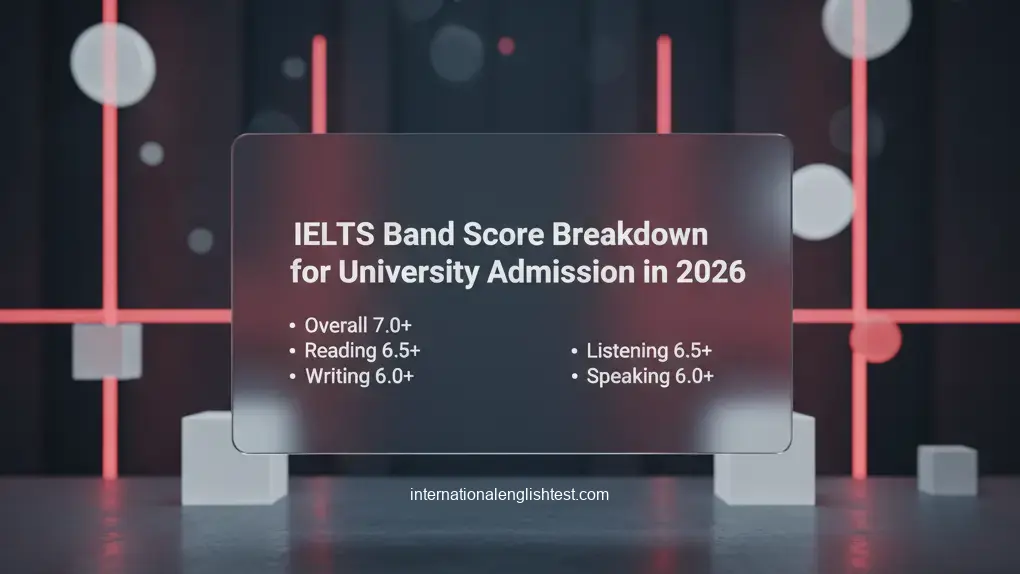
IELTS band score requirements for university admission in 2026 typically range from 6.0 to 7.5, depending on program competitiveness and level of study. Most top universities demand higher IELTS scores for postgraduate programs than undergraduate ones. Meeting these requirements is non-negotiable if you want your application taken seriously.
Many students realize only after submitting their applications that understanding the score breakdown can influence not just eligibility but also scholarship opportunities. If you want to check my English level before applying, use this simple tool to get an instant score: check my English level.
IELTS Band Scores vs. 2026 University Admission Requirements Table
Universities in 2026 are raising their English language bar. Programs in law, medicine, or business often demand higher IELTS band scores than the university’s general minimum. For example, a business major might need a 7.0 overall, while the same school’s humanities department accepts 6.5. These benchmarks can mean the difference between an offer and a rejection—as crucial as a passport when you board a plane. Here’s a mapped-out comparison covering leading global universities and their 2026 IELTS minimums, so you know which targets are realistic and where you’ll need to aim higher.
| University | Country | Undergraduate (UG) | Postgraduate (PG) |
|---|---|---|---|
| University of Oxford | UK | 7.0 (min 6.5 in each) | 7.5 (min 7.0 in each) |
| University of Toronto | Canada | 6.5 (6.0 in each) | 7.0 (6.5 in each) |
| University of Melbourne | Australia | 6.5 (6.0 in each) | 7.0 (6.5 in each) |
| National University of Singapore | Singapore | 6.5 | 7.0 |
| University of California, Berkeley | USA | 7.0 (min 6.0 in each) | 7.0 (min 6.5 in each) |
- Elite programs often set the bar higher than university-wide policies.
- Individual faculties (like Law or Medicine) may have exceptions—always check specific department pages.
IELTS isn’t the only language test accepted. Universities globally recognize IELTS, TOEFL, PTE Academic, and the International English Test (IET). These options differ in test format, acceptance, and validity—which can play a significant role if you’re switching countries or re-testing. When choosing, think of it like picking a phone plan: not every provider covers every region equally. This chart lists what you need to know to compare, side by side:
| Exam | Accepted In | Format | Typical IELTS Equivalent | Score Validity |
|---|---|---|---|---|
| IELTS | Worldwide | Paper/Computer | 6.0–9.0 scale | 2 years |
| TOEFL iBT | Worldwide | Internet | 80–115 (6.0–9.0 equiv.) | 2 years |
| PTE Academic | Australia, UK, Canada, US | Computer | 50–90 (6.0–9.0 equiv.) | 2 years |
| International English Test (IET) | Europe, Asia (emerging) | Online | CEFR-mapped | 2 years |
How IELTS Band Scores Affect Undergraduate vs. Postgraduate Applications
Undergraduate (bachelor’s) applicants usually need a lower minimum band score than postgraduate (master’s, doctorate) applicants. A 6.0 might open doors at the undergraduate level, but postgraduate admissions—especially in competitive faculties—start at 6.5 or 7.0, and certain scholarships set the bar even higher. Think of it like marathon running: undergrads compete in a city fun run, but postgrads face a national championship.
Some faculties ramp up language demands even further. For 2026, engineering, health sciences, and business schools often require 0.5 to 1.0 bands above the standard. If you’re keen on law, medicine, or education, don’t be surprised if the English criteria rise—a reality students encounter at every high-ranking university. For specific programs, reviewing recent insights on Top Online English Test Errors That Can Harm Your Job Search will deepen your understanding and can help you avoid costly mistakes.
- PG (master’s) admissions expect more mature, fluent applicants—no exceptions.
- Your score in writing and speaking often matters most for scholarships.
- Failing to meet just one band (e.g., reading at 5.5) can disqualify even with a high overall score.
Recognized IELTS Score Validity and Re-Testing Policies in 2026
For 2026 admissions, universities worldwide recognize IELTS scores as valid for up to two years from your test date. If your scores are dated before this window, you’ll need fresh results, no exceptions. It’s a bit like using a credit card: after the expiry date, it’s worthless for applications, no matter your balance.
If you don’t meet the minimum required band, nearly all universities allow a retest—sometimes with a short waiting period (often 3–7 days) between attempts. You can retake the exam as many times as needed, but universities may see a history of repeated testing, so ideally aim for your target on the first or second try.
- Score validity is typically a fixed two-year period, strictly enforced.
- Re-testing is always possible, though planning and prep matter more than repeated tries.
- Some universities may allow alternate English evidence IF your IELTS expired during pandemic-related disruptions, but never assume—always confirm in writing.
Set a mock test date within seven days and simulate the full IELTS format at home—timed, distraction-free, no pauses. This won’t just show your weaknesses, it’ll expose the exact band (and sub-score) you’re working with so you don’t get ambushed on test day.
FAQ
Can I use an old IELTS score for 2026 university admissions?
No, most universities only accept IELTS scores from tests taken within two years of the application deadline. If your score is older, you’ll need to retake the test.
What happens if I miss the minimum band in one section?
If you fail to meet a section minimum, even with a high overall score, most universities will not consider your application until you meet all their requirements.
Is IELTS easier than TOEFL or PTE for university admissions?
It depends on your strengths: some students find IELTS speaking and writing more approachable, while others prefer the all-computer TOEFL or PTE experience. The decision really comes down to test format preference.
How soon can I retake IELTS if I don’t pass?
You can register for another IELTS test almost immediately, but it’s smarter to give yourself at least one week to review your results and practice before reattempting.
Do scholarships require higher IELTS band scores?
Many merit-based scholarships set IELTS minimums above standard admission—sometimes by 0.5 or even a full band. Always check the specific scholarship details carefully.