For university admission in 2026, you must take the IELTS Academic test, not the General Training version. The minimum required scores depend on your target university and faculty: most leading schools now require an overall 6.5–7.0, with no band lower than 6.0. Changes coming in 2026 include updated question types and stricter score requirements for many programs.
Getting into global universities means understanding exactly which English exam version is required, meeting or exceeding its score, and planning around significant application deadlines. It’s easy to underestimate just how specific these requirements have become; top programs don’t compromise. If you’re unsure about where you stand today, check my English level—clarity is everything this year.
IELTS Academic vs General: Comparison Table for University Admission 2026
Universities worldwide demand IELTS Academic results for admission—not General Training—because the Academic version measures skills directly related to academic study. The General version assesses broader English ability for work or migration, not classroom readiness. Here’s how they stack up when considering university entry requirements for 2026:
| Feature | IELTS Academic | IELTS General Training |
|---|---|---|
| Test Sections | Listening, Reading (Academic), Writing (Academic), Speaking | Listening, Reading (General), Writing (General), Speaking |
| Timing | ~2 hours 45 minutes | ~2 hours 45 minutes |
| Score Range | 0–9 (half band increments) | 0–9 (half band increments) |
| University Acceptance (2026) | Accepted globally for undergraduate and postgraduate programs | Rarely accepted for university admission, mostly not valid |
Treat the Academic and General as two different tracks—like wearing running shoes for a marathon vs. hiking boots for a trail. Both get you somewhere, but one is clearly designed for the specific path you must run.
Minimum IELTS Scores Required by Leading Universities in 2026
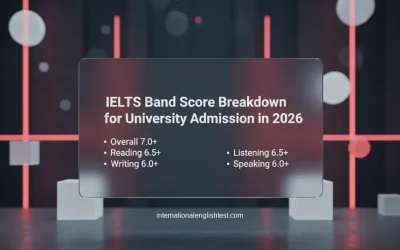
If you want that acceptance letter, minimum IELTS scores are non-negotiable. Top universities, especially in the UK, Australia, and Canada, are rising their score cutoffs for 2026 admissions. There are two hurdles: your overall band score and your section scores. For example, the University of Toronto requires a 7.0 overall but won’t accept anyone with less than 6.5 in Reading and Writing. The University of Sydney’s Law Faculty? They often expect a 7.5, with minimums in each band.
- Minimum overall: 6.5–7.5 depending on institution
- No individual skill (Reading, Listening, Writing, Speaking) below 6.0 for top programs
- Some programs (Medicine, Law, Education) demand even higher band minimums
One overlooked detail: many faculties use an auto-reject filter for any single band below their threshold, even if your average is higher. That single weak spot can close a door. If you plan on aiming for scholarships or highly competitive departments, making all skills airtight matters—more than ever. For detailed practice and to find tools that reflect real admission conditions, see the Best Free Online English Test Simulators for University Admissions, which replicate the pressure and structure you’ll face on test day.
Key Changes to the IELTS Test Structure and Scoring in 2026
This year, IELTS introduces new question formats in Reading and Writing, along with minor tweaks to marking rubrics. They’re adding integrated tasks (blending charts and essay writing) and expanding authentic academic vocabulary usage in test prompts. It’s not just about checking your grammar; it’s about showing you can adapt ideas quickly and express complex arguments, much like juggling several balls instead of just tossing one handover to the other.
Scoring is also tighter. Automated checks will flag scripts with memorized answers or formulaic phrases. Universities will see a more detailed score breakdown, so it’s harder to mask a low band score with high performance in another.
Test prep strategies need to evolve. It’s no longer about cramming set phrases—it’s about learning to think, analyze, and write on your feet. Consistency and genuine practice matter here, just as muscle memory makes the difference for an athlete under pressure.
Official IELTS Test Dates, Registration, and Validity for Application
The window for 2026 IELTS testing is narrower for university applicants—many deadlines move earlier due to increased competition. Major test centers now offer Academic IELTS on 48 fixed dates, roughly four times a month. Register early, especially if you need a test in September or October, as those slots fill up as quickly as the best concert tickets and rescheduling last minute rarely works out.
- Score validity: IELTS results are valid for two years from the test date.
- Registration: Online registration opens 4–6 months in advance for most locations.
- Submission: Some universities require scores be sent directly by IELTS, not by the student.
Factor in processing time when choosing your date—universities have zero tolerance for late documents. Plan at least three months ahead to handle unexpected delays or the need to retake the test for a higher score.
Use one full test simulation under timed conditions this week—even before you feel ready. Experiencing the real format, warts and all, highlights skills to fix now rather than in panic. It’s the difference between knowing the rules of football and playing a live match—practice changes everything.
FAQ
Can I use IELTS General Training for university admissions in 2026?
No, universities almost always require IELTS Academic for degree-level study. General Training is generally accepted for migration or vocational programs only.
What is the minimum IELTS score for top universities in Canada and the UK?
For many leading institutions, an overall band of 7.0 is standard, though some programs accept a 6.5. Check each faculty’s website for section score minimums.
How long are my IELTS scores valid for university applications?
Scores remain valid for two years after your test date. Submit them within this window, or you’ll need to retake the exam.
What’s different about the 2026 IELTS test compared to previous years?
The 2026 version introduces new integrated task types and updates some marking rubrics. Expect more academic vocabulary and fewer opportunities to rely on memorized phrases.
How early should I book my IELTS test for 2026 university entry?
Book at least four months before your first application is due. Slots can fill up quickly, especially during peak admission seasons.