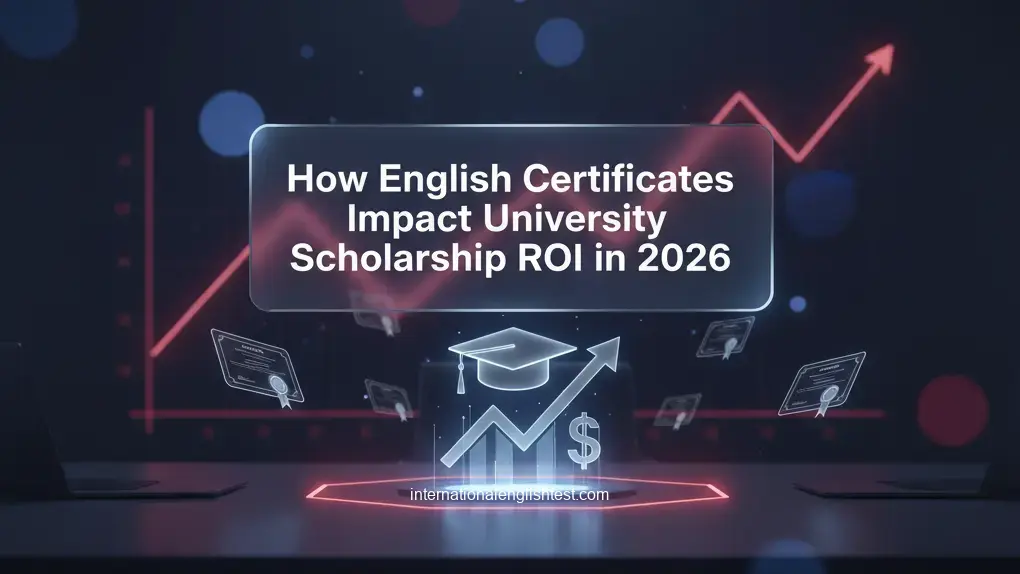
English certificates like IELTS, TOEFL, and PTE will have a direct impact on university scholarship eligibility in 2026. The certificate you choose shapes both where you can apply and the total financial benefit you’ll get from a scholarship offer. Those aiming for top universities should match certificate type and level to scholarship requirements for the biggest return on investment.
If you want to know where you stand before applying, you’ll want to check my English level to avoid surprises in the process.
Certificate Recognition and Scholarship Eligibility: Key Comparisons (2026 Table)
Universities are not equal in the English certificates they accept, and neither are the scholarships they offer. Some certificates—like IELTS and TOEFL—are accepted by nearly every major university, while national English tests or newly introduced digital tests see limited recognition. If your goal is maximum scholarship eligibility and less bureaucracy, choice of certificate is step one.
| Certificate | Global Recognition | Accepted for Full Scholarships | Typical Validity | 2026 Cost Estimate (GBP) |
|---|---|---|---|---|
| IELTS Academic | Widespread | Yes | 2 Years | £205 |
| TOEFL iBT | Widespread | Yes | 2 Years | £190 |
| PTE Academic | High | Yes | 2 Years | £180 |
| National Tests | Variable | Limited | Varies | £40-£100 |
| International English Test (IET) | Growing | Partial | 2 Years | £65 |
Choosing a test is like picking the right currency before going abroad—some get you into many countries, a few only work at home, and others are finally finding space in the global wallet.
- IELTS and TOEFL: Accepted nearly everywhere, higher cost, fast renewal cycles.
- PTE: Growing in recognition, marginally cheaper and digital-centric.
- National Certificates: Rarely cover the full spectrum; low cost, but limited ROI at elite universities.
- IET: Rapid expansion past 2024, but check if your chosen school lists it for the year you’re applying.
Accepted English Certificate Levels for Top Local Universities
Top universities rarely move the goalposts when it comes to minimum language requirements. The CEFR (Common European Framework of Reference) is the benchmark—most full scholarships require at least a B2 or C1 level, typically equating to IELTS 6.5, TOEFL iBT 90, or PTE 58. For partial scholarships, B2 may suffice, but competition is fierce. It’s a bit like admission tickets for a headline concert: balcony seats are easier to get, but only those up front get you noticed by scholarship committees.
If your aim is the full scholarship route, expect to be asked for a higher-level certificate (C1 Advanced), especially in competitive faculties. Even for partial support, slipping below the minimum is a non-starter. When planning your applications, keep in mind the nuances explained in this resource on What Is the Average UK Salary for B2 English Speakers?—language level pays off beyond just admissions.
- Full scholarships: Target C1 or higher, verified by a recent IELTS, TOEFL, or equivalent certificate.
- Partial scholarships: B2 minimum, but requirements may shift in STEM fields or postgraduate programs.
- Always check the latest university bulletins before committing to a test date.
Validity, Renewal, and Acceptance Policies for Scholarship Applications
Every certificate has an expiration. Standard policies hold a maximum validity of two years for IELTS, TOEFL, and PTE—after that, it’s back to the exam hall. National tests sometimes last longer if tied to state education, but universities can (and often do) change their acceptance lists each year. For 2026, at least four major UK universities updated their policies to exclude certificates older than 18 months at the time of scholarship application. It’s unpredictable, like saving supermarket vouchers only to find the rules changed overnight.
If you’re applying for September 2026 intake, make sure your scores remain valid through the exact cutoff for document submission. Don’t risk relying on a test date from early 2024. Monitor official university pages monthly; policy changes can be buried in footnotes until it’s too late to retake.
- Check acceptance windows—some universities allow certificates obtained within 18 months, not 24.
- Digital and online test formats are gaining but always verify their acceptance status for 2026.
- If in doubt, email admissions directly for written confirmation.
Before you pay for a top-tier certificate, download the exact scholarship and admissions guide for every university on your list. Create a quick spreadsheet ranking accepted tests, validity cut-off, and last accepted application date. Taking 20 minutes to map out your options can prevent wasted fees and missed scholarships.
FAQ
Which English certificate gives the best chance of scholarship success?
IELTS and TOEFL consistently unlock the most scholarship options at leading universities, but it always depends on the specific institution’s policy for the year you’re applying.
Can I use a national English test for scholarships abroad?
National tests are usually limited to institutions within one country. If you’re targeting international universities, opt for a globally recognized certificate like IELTS, TOEFL, or PTE.
How long is my English certificate valid for scholarship applications?
Most certificates are valid for two years, but some universities have begun imposing an 18-month rule. Always verify current policy before you apply.
Is a higher certificate level (C1/C2) worth the extra effort?
Yes. A C1 (or higher) certificate not only opens up more scholarships but also increases your competitiveness for academic programs and future job opportunities.
Can I combine English certificates if one is expired?
No. Universities only accept active, valid certificates that meet their minimum requirements—not a mix of outdated results.
Before you invest time or money, review the requirements for your target scholarships and universities. The certificate you hold shapes not just your odds of winning, but the true financial value of your university years.