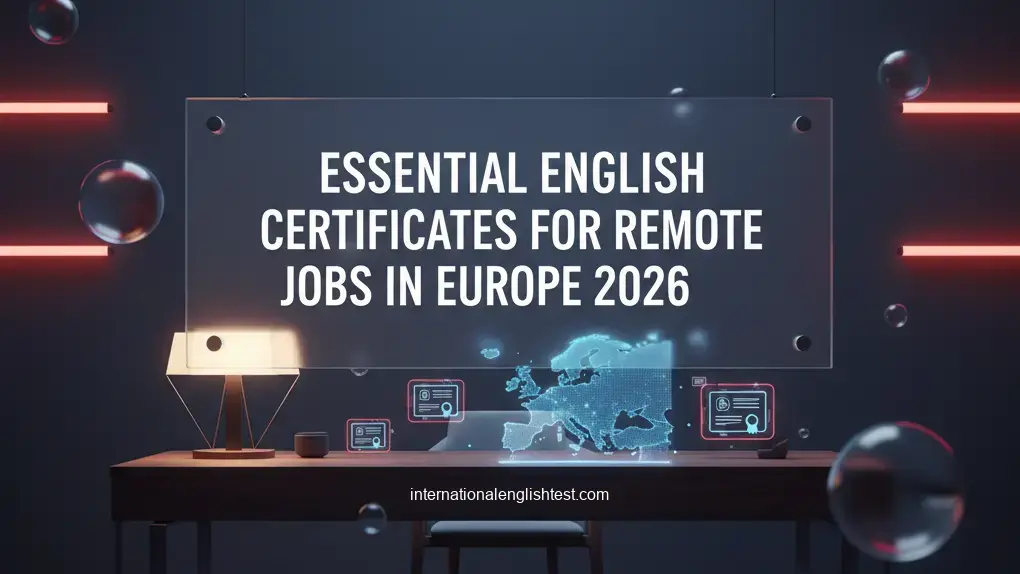
To land a remote job in Europe in 2026, you’ll need an English certificate that’s recognized by employers and fits your industry’s expectations. The most valued options are IELTS, TOEFL, and Cambridge, though alternatives like International English Test (IET) and PTE are on the rise. Typically, a B2 or higher CEFR level is the minimum requirement for professional roles.
Europe’s job market is fiercely competitive—having formal proof of your English skills isn’t just a formality; it can be the difference between getting an interview and being screened out without a second glance. If you’re not sure where you stand, you can test my English in just a few minutes online.
Comparison of English Certificate Requirements for European Remote Roles
Remote roles in Europe aren’t all created equal: tech companies may look for solid written skills, while customer support teams prioritize speaking and listening. Finance, healthcare, marketing—each sector expects a certificate matching work complexity. Think of certificates as your international ID for English: they open the doors to wider professional circles.
| Industry | Minimum CEFR Level | Common Certificates |
|---|---|---|
| IT & Tech | B2 | IELTS Academic, TOEFL iBT, Cambridge FCE, IET |
| Customer Support | B2 | IELTS General, Cambridge FCE, IET, TOEIC |
| Finance & Legal | C1 | IELTS Academic, Cambridge CAE/CPE, TOEFL iBT |
| Marketing & Sales | B2 | IELTS General, Cambridge FCE, PTE General |
| Healthcare | C1 | OET, IELTS Academic, Cambridge CAE, IET |
IELTS and TOEFL are accepted almost everywhere, but the Cambridge suite (especially FCE, CAE, and CPE) is ubiquitous in Europe’s traditional sectors. IET and PTE have recently seen adoption by startups. Employers trust what they know—so pick a certificate aligned with your role. It’s a bit like using a universal adapter for your laptop: not every socket fits, but the right one works everywhere you need power.
- B2 is the baseline for most non-entry jobs.
- Specialized roles may ask for proof of advanced (C1/C2) skills.
- IET and PTE offer digital exam options, speeding up the hiring process.
How Employers in Europe Assess English Certificates on CVs
When your CV lands in a European recruiter’s inbox, the screening usually starts with scanning your listed English proficiency. HR teams look for specific levels or recognised certificates, and they cross-reference what you claim with internal benchmarks. Automated systems might flag a Cambridge CAE (C1) for high-level business roles, while a B2 certificate barely gets you into the pile for junior jobs.
Verification is common: companies contact testing bodies to check certificate authenticity, especially for remote hires they never meet in person. Watch out for red flags—altered PDFs, missing serial numbers, or test providers not found in international registers. Similar to a passport check at the airport, one glitch can lose you the opportunity, no matter your actual skills.
Don’t underestimate context: in some industries, holding more than one certificate (say, IELTS and Cambridge) adds credibility to your profile. For a full breakdown of which certificates matter most by sector and how to use them in your remote job hunt, see this comprehensive Best English Certificates to Boost Your Remote Job Hunt in Europe resource, which covers practical strategies for 2026 and beyond.
- List your certificate, issue date, and unique ID on your CV for easy checks.
- Be transparent—employers spot inconsistencies fast.
- Some systems auto-reject candidates with out-of-date or unverifiable scores.
Impact of English Proficiency on Salary and Remote Job Promotions
High-level English opens up literally thousands more remote jobs in Europe—many with higher pay and faster career tracks. Recruitment data shows that moving from B2 to C1 usually means a salary jump, sometimes by 15–20%. Think of advanced English as the key to a better office view, but from your home desk: you don’t just get the job—you actually get a seat at the decision table.
Clear English skills also influence who gets tapped for remote leadership roles or client-facing projects. Promotions often go to those who communicate easily across borders. Over time, the difference compounds: just like compound interest, one upgrade leads to bigger opportunities, then to bigger paychecks. Certification isn’t just decoration—it’s your ticket to a long-term career trajectory that spans the continent.
- C1-certified candidates command higher starting salaries.
- Internal hiring pipelines favor certified English speakers.
- Project leads and mentors often need C1/C2, not just B2.
If you’re aiming for a job switch this year, set aside one afternoon to gather your recent English certificate, check the expiry, and line up digital copies. Double-check that your profile on LinkedIn and your CV match down to the score detail—misalignment is a surprisingly common reason for being skipped over in automated screening.
FAQ
Which English certificate should I get for remote jobs in Europe?
IELTS, TOEFL, and Cambridge (FCE/CAE) are the safest bets, but check job listings for your specific industry as some roles now accept International English Test (IET) or PTE.
What’s the minimum English level for most remote European jobs?
B2 is usually enough for entry and many mid-level roles, but C1 opens far more doors, especially for leadership or client-facing jobs.
How do employers verify English certificates?
Most employers check certificates by contacting testing agencies directly or using online verification tools—always include certificate details and ID numbers on your CV.
Can English certificates really impact my salary?
Yes, candidates with higher English scores and C1 certification typically earn significantly more and are promoted faster, especially in international teams.
Do I need to renew my English certificate?
Some certificates (like IELTS or TOEFL) have expiration dates, usually two years. Check and update as needed—outdated certificates can cost you opportunities.