The IELTS exam in 2026 consists of four main sections: Listening, Reading, Writing, and Speaking. Each section is scored on a band scale from 1 to 9, and your overall score plays a crucial role in university admissions, especially for competitive programs. Knowing the structure, timing, and scoring details is essential if you’re aiming for higher education or professional recognition in English-speaking contexts.
When you know the structure, you can prepare smarter, so if you want to check my English level, there’s a simple way to start.
IELTS Test Sections Compared: Format, Timing, and Scoring Table
Preparing for IELTS? You’ll face four unique sections. Listening tests your ear for detail, Reading checks how fast you process information, Writing pushes your argument and logic, while Speaking is all about real-world communication skills. Timing matters here—a slow reader can’t make up time elsewhere. Each part has its own scoring band. If you’re thinking about alternatives like TOEFL, PTE, Cambridge, or the International English Test (IET), take a close look at the structure, question types, and how scores work. It’s a bit like comparing four different sports—each requires distinct strategies and strengths.
| Exam | Sections | Total Duration | Score Range | Accepted by Universities | Score Validity |
|---|---|---|---|---|---|
| IELTS | Listening, Reading, Writing, Speaking | 2 hours 45 minutes | 1-9 bands (per section and overall) | Global | 2 years |
| TOEFL iBT | Reading, Listening, Speaking, Writing | 1 hour 56 minutes | 0-120 (total score) | Global | 2 years |
| PTE Academic | Speaking & Writing, Reading, Listening | 2 hours | 10-90 | Global | 2 years |
| Cambridge C1 Advanced | Reading & Use of English, Writing, Listening, Speaking | About 4 hours | 160-210 | Global | Indefinite |
| International English Test (IET) | Listening, Reading, Writing, Speaking | 2-3 hours | A1–C2 (CEFR) | Selected institutions | 2 years |
- IELTS has four distinct sections, each critical for different strengths.
- PTE and TOEFL offer speed, but the task mix differs.
- IET and Cambridge exams focus more on European CEFR alignment, relevant if porting results across certification systems.
Curious about test pacing? Learn more in this detailed guide: How long does the CEFR test take?
How IELTS Scores Impact University Admission Criteria in 2026
Admissions rules are shifting. In 2026, universities rely on IELTS more than ever to gauge academic readiness and language adaptation. Think of your IELTS score as an entry ticket. Without the right band, the door won’t open for you — especially at top-tier institutions.
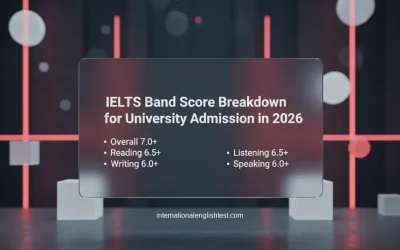
Here’s where things split: top national universities almost always require an overall band of 6.0 for undergraduates. For postgraduate programs, you’ll often face a 6.5 or 7.0 bar, sometimes higher for law, medicine, or STEM. A single band below 5.5 can break your chances, even with a solid average.
- Minimum requirements vary by course — competitive degrees expect more.
- Some programs set separate cut-offs for each skill, not just your total average.
- Know your target: Business, Law, and Medicine typically require the highest scores.
Institutional Recognition: Which Universities Accept IELTS in Your Country?
If your eyes are set on a local degree, nearly every major public and private university accepts IELTS. The exam doesn’t just open doors — it shapes which degree tracks you qualify for directly and which funnel you into foundation (pre-degree) pathways. It’s a bit like showing a passport at border control; without it, you go no further.
At the undergraduate level, IELTS is now mandatory for most direct entry degree courses in business, science, engineering, arts, and healthcare. Exceptions exist for joint courses with heavy local-language content. Many institutions offer foundation programs (lasting one year) if your score falls just below their direct entry level. Recent policy updates often remove this flexible safety net, tightening language benchmarks, especially for international students. Always double-check admissions pages—policies can change with little warning.
Before submitting your university application, schedule a full timed practice IELTS test at home and grade yourself with official materials. Spot your weakest section and create a 7-day plan to improve just that skill. This targeted approach can boost your composite score faster than random practice.
Frequently Asked Questions about IELTS Scoring and Admissions
How is the overall IELTS score calculated?
Your overall IELTS score is the average of your four section scores, rounded to the nearest half band. If your averages fall between bands, official IELTS rounding rules apply.
Can I combine results from separate IELTS exams?
No, universities typically require a single IELTS Test Report Form from one sitting. Some exceptions exist for schools accepting a ‘superscore,’ but this is rare—always check directly.
How long is my IELTS score valid?
IELTS scores are valid for two years from your test date. Universities will not accept scores that expire before your intended start date.
How soon can I retake IELTS after a failed attempt?
You can book another IELTS exam immediately—there’s no mandatory waiting period. Most applicants wait at least two weeks to study up on weak areas.
What’s the difference between section band scores and overall score?
Section scores reflect your ability in Listening, Reading, Writing, or Speaking separately. The overall score is the average, which is what universities mainly use for admissions.
- IELTS is a skilled-based test; treat each section as a different sport.
- Top institutions require higher bands for both undergraduate and postgraduate admissions.
- Score policies do change, especially after global policy reviews or migration changes, so always verify requirements.
Ready to move forward? Focus on mastering your weakest IELTS skill and start your preparation ahead of deadlines for competitive programs in 2026.