To apply for most Chinese universities in 2026, a valid English certificate mapped to the CEFR is a must. Verification for authenticity is straightforward if you follow official steps, and each certificate—like IELTS or TOEFL—is mapped to a specific CEFR level by consensus. If you’re preparing for university admission in China, understanding the certificate level and validation process isn’t optional; it’s the baseline.
China’s college entrance requirements have changed rapidly in recent years, and as English language standards become more explicit, knowing exactly where you stand matters more than ever. To instantly find my CEFR level, many applicants now use online assessment tools before diving into applications.
2026年中国主流高校CEFR证书级别与入学要求一览表
China’s top universities have drawn a clear line: admissions depend on meeting fixed CEFR levels. For those aiming at Project 985 or 211 universities, a B2 CEFR certificate is the base line—period. Others won’t even consider your application. For mid-tier universities, you might squeeze in with a B1, but that’s increasingly rare. It’s like a sports tournament: without the right ticket, you don’t get in the door.
- Project 985/211 universities: Most demand at least CEFR B2 or equivalent.
- General comprehensive universities: Some accept CEFR B1, though this is changing fast.
- Specific majors (Law, Medicine, Engineering): Often want an even higher mark—sometimes C1.
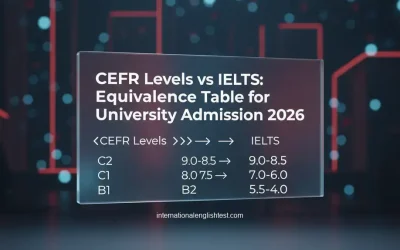
Every major English certificate has a published equivalence to CEFR, so don’t just check your raw scores—know their mapped level. Here’s a snapshot that makes the comparisons plain:
| Exam | CEFR B1 | CEFR B2 | CEFR C1 | Score Validity |
|---|---|---|---|---|
| IELTS Academic | 4.0 – 5.0 | 5.5 – 6.5 | 7.0+ | 2 years |
| TOEFL iBT | 42 – 71 | 72 – 94 | 95+ | 2 years |
| PTE Academic | 35 – 42 | 50 – 59 | 67+ | 2 years |
| Cambridge (FCE/CAE) | FCE (Pass) | FCE (Good) | CAE (Pass) | Unlimited |
| International English Test (IET) | score 51 – 65 | score 66 – 79 | score 80+ | 2 years |
CEFR证书查验平台及官方验证流程详解
Verification matters just as much as your score. Without a confirmed, valid CEFR-level certificate, your application won’t even get reviewed. The Ministry of Education routinely reminds students to use official verification sites only. Using unofficial platforms is like buying a train ticket from a stranger—you might end up nowhere.
Go straight to the certificate’s official website (such as IELTS.org, ETS.org for TOEFL, or CambridgeEnglish.org). Enter your unique Test Report Form (TRF) number or digital code. This step is non-negotiable. Even top schools double-check these records for fakes.
- Never upload scans to non-official third-party sites.
- Direct verification steps: visit the official English certificate platform > input your code or scan the QR > confirm the match and validity dates.
- Common issue: Expired certificates are routinely rejected, no matter how high your score.
Institutions or employers also request an online verification, so keep your official digital copy handy at all times.
国际标准对接:CEFR与雅思、托福等证书有效性说明
2026 brings tighter alignment of Chinese entry policies to global norms. All leading universities now accept mainstream English tests, but only if mapped to CEFR levels. This is more than paperwork—think of CEFR as the international ‘currency’ for language skills. Miss this conversion, and your score means nothing locally.
Undergraduate and master’s admission policies have upgraded. Major authorities use equivalency guides, and it’s vital to understand how your particular score sits on this CEFR ladder. For a breakdown of B2 and C1 equivalence for Chinese university entrance, the resource CEFR B2 vs C1 Certificate: University Admission Equivalence Explained offers a detailed comparison and is worth a look for those stuck between levels.
- Policy updates: Only certificates with official CEFR mapping get recognized.
- Mutual recognition: TOEFL, IELTS, PTE, Cambridge, and IET are all interchangeable—if their level is right.
- Ongoing change: Some regional universities still using local benchmarks may upgrade to CEFR-only by 2026.
It’s a bit like international driving permits. Your home license might impress in your country, but without the right equivalence, border guards just shrug. That’s the logic behind CEFR as the shared checkpoint for language qualifications in China now.
Take five minutes today to log in to your English certificate’s official verification platform. Check the validity date and download a fresh digital copy right now—more than one applicant’s offer has evaporated because they used an expired or non-certified version. This quick check will spare you hours of future panic.
FAQ
What is a CEFR certificate and why do Chinese universities accept it?
A CEFR certificate is an official document proving your English proficiency, graded by international standards. Chinese universities use this system for consistent, fair language admission checks.
How do I verify if my English certificate is valid for 2026 entry?
Use your exam’s official website to enter your certificate number or scan the QR code. Only official online verification records are accepted.
What if my English certificate expired but I had a high score?
Expired certificates are not accepted for university applications, no matter the original score. Always check your certificate’s validity before applying.
What’s the difference between B2 and C1 for Chinese university admission?
B2 is the minimum for top universities, but competitive programs or majors may prefer or require C1. Refer to your targeted school’s admission guide for specifics.
Can I use an International English Test (IET) result for Chinese universities?
Yes, if your IET score is mapped to the required CEFR level and verified through the official site, it will be recognized just like IELTS or TOEFL.