
Take International English Test, Certify Your CEFR English Level!
- ✓Take the English test online – anywhere, anytime
- ✓Find out your CEFR English level (A1–C2) instantly
- ✓Get your verified English certificate immediately


0+
Certificates Issued
0+
Countries
Choose your test.
Full CEFR assessment, single-level tests, or skill-specific exams. Instant verified certificate either way.
Three steps. No appointments.
From start to verified certificate, the entire process takes under 30 minutes — and works on any device.
Take the test
60 multiple-choice questions covering grammar, vocabulary, reading and listening. Calibrated against the CEFR scale.
See your CEFR level
Your CEFR level (A1–C2) appears the instant you finish. Grammar, vocabulary, reading and listening broken down separately.
Download certificate
Verified certificate with QR code, ready for your CV, LinkedIn, or university admissions in 210+ countries.
Try a real question right here.
Most English tests ask you to commit before you see what you're getting. We'd rather show you how the test feels first — same UI, same difficulty calibration, same real-time feedback.
- Calibrated against the CEFR (Common European Framework)
- No tricks, no time pressure — just honest measurement
- Validated against IELTS and TOEFL benchmarks
Choose the correct option:
“If I earlier, I would have caught the train.”
One test for the level. Two more for what comes next.
Choose between the English Level Test for CEFR certification (A1–C2), a Speaking & Writing AI assessment, or Eng4Skills for a complete four-skill evaluation. Not sure of your level? Start with the General English Test.English Level Test
The fast, accurate CEFR level test. Covers grammar, vocabulary and reading. Ideal for CV, jobs and university applications.
Speaking & Writing
Practice and assess speaking and writing with AI-graded feedback in seconds. Powered by speech recognition and LLM scoring.
Eng4Skills
The complete assessment. Reading, listening, speaking, writing — all in one session. The most rigorous IET certificate.
Already know your level?
Take a level-specific test — same certificate, focused difficulty. From £15.99.
Speak. Write.
Get scored in seconds.
No examiner. No scheduled appointment. No waiting two weeks for a result. Speak into your microphone or write directly in the browser — get CEFR-aligned scoring back in under a minute, available 24/7.
“Describe a place you visited recently and why it was memorable.”
A certificate worth showing.
Designed to look credible on a CV, in a university application, and on LinkedIn — with verifiable proof underneath.
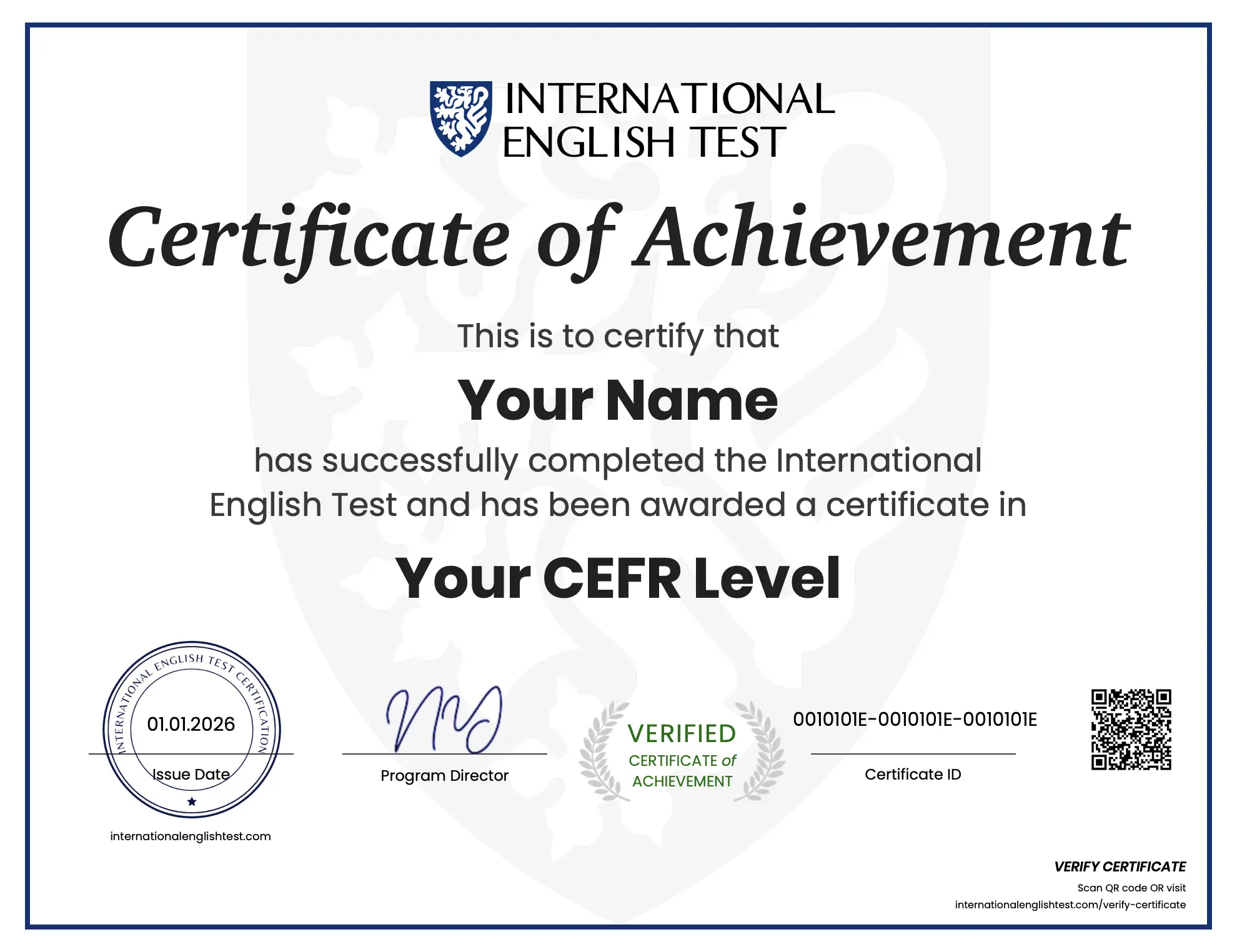
Recognised and verifiable.
Every certificate carries a unique ID and QR — checked instantly by employers, universities and visa officers in 210+ countries.
- 1
Issuing authority
International Test Limited (UK), ALTE Associate Member.
- 2
CEFR level + descriptor
Standardised across Europe — universally interpretable.
- 3
Unique verification code
Each certificate has its own ID — impossible to forge.
- 4
QR for instant check
Scan to confirm authenticity in 1 second — no login needed.
Result Report
Your Name
Tested 25 Apr 2026 · 60 questions answered
B2.2
Upper-Int.
AI Insight
Strong reading comprehension at C1 level. To reach overall C1, focus on conditional grammar forms and lower-frequency academic vocabulary.
Beyond a single result report.
The result report unpacks your performance by skill — so you know what you're strong at and exactly where to go next.
- 1
CEFR sub-band
Not just B2 — B2.2, with how close you are to C1.
- 2
Skill breakdown
Grammar, vocabulary and reading — measured separately.
- 3
AI-generated insight
A personalised note on what specifically to work on next.
- 4
Shareable summary
A clean PDF version employers can read in 10 seconds.
Common European Framework CEFR Levels
The Common European Framework of Reference (CEFR) defines six English proficiency levels — from A1 (Beginner) to C2 (Proficient). Find out your CEFR level with our online English test, then explore detailed level descriptions below.

A1
Beginner
English level A1 is the first level of English in the Common European Framework of Reference (CEFR), a definition of different language levels written by the Council of Europe. In everyday speech, this level would be called "beginner", and indeed, that is the official level descriptor in the CEFR. Students at A1 can understand and use familiar everyday expressions and basic phrases.
Learn more about A1→
A2
Elementary
English level A2 is the second level of English in the CEFR. This level might be described as "basic" — as in "I speak basic English". The official level descriptor in the CEFR is "elementary". At this level, students have mastered the basics of English and can communicate simple, basic needs. A2 English is the foundation for independent English use.
Learn more about A2→
B1
Intermediate
English level B1 is the third level of English in the CEFR. In everyday speech, this level would be called "intermediate". At this level, students are beyond the basics but they are still not able to work or study exclusively in English. B1 English speakers can handle familiar topics, describe experiences, and produce simple connected text.
Learn more about B1→
B2
Upper-Intermediate
English level B2 is the fourth level of English in the CEFR. This level might be called "confident", as in "I am a confident English speaker". The official level descriptor is "upper intermediate". B2 English speakers can function independently in a variety of academic and professional environments in English, although with a limited range of nuance and precision.
Learn more about B2→
C1
Advanced
English level C1 is the fifth level of English in the CEFR. In everyday speech, this level would be called "advanced", and that is the official level descriptor. At this level, students can function independently and with a great deal of precision on a wide variety of subjects and in almost any setting without any prior preparation. C1 is the level employers and universities look for.
Learn more about C1→
C2
Proficient
English level C2 is the sixth and final level of English in the CEFR. This level might be called "bilingual". A well-educated native English speaker is technically at a C2 level. Relatively few English learners reach this level because their professional or academic goals do not require it. C2 proves exceptional mastery of English.
Learn more about C2→Wherever your English level matters.
An IET English certificate is your proof of English level — recognised worldwide and ready for any application.
For Your CV
Add your CEFR English level to your CV with confidence. Our online English test makes your language skills verifiable to hiring managers with a unique verification code.
English certificate for CV→For Job Applications
Many employers require proof of English proficiency. Your IET certificate demonstrates your level with online verification for HR teams.
English certificate for jobs→For University Admissions
Prove your English level for university applications worldwide. Our CEFR-aligned certificate is accepted in 210+ countries.
English certificate for university→For Immigration & Visa
Document your English proficiency for visa and migration. An internationally recognised certificate strengthens your application.
English certificate for immigration→Faster. Cheaper. Just as credible.
For CV, jobs and university applications, IET delivers the same CEFR result as the global tests — without the £200 fee or two-week wait.
← Swipe to compare →
The Most Practical English Certification
Convenient
Take the test online anywhere, anytime — no traveling to a test center or appointment needed.
Fast & Accurate
Get your results within 5 minutes of completing the test, covering all 6 CEFR levels — from A1 to C2.
Affordable
Receive your English level and certificate from only £15.99, while most other certification tests cost over £200.
Certified
You'll get an English Certificate when you complete the test and can share it on LinkedIn and put it on your resume.
What Our Students Say
“I wanted to write my English level correctly on my CV. This test was very practical and gave very good results. So I got my English Level Certificate right away, I was able to write my English level on my CV as I wanted. Thanks!”

Jane Watson
Digital Marketing Specialist
“I wanted to learn my level to improve my English for a long time. This English test was very helpful in determining my level and seeing myself. I also got my English certificate right away. Thank you for learning my English level easily today.”

Arnold Smith
Full-time Student Abroad
“The employer verification feature is excellent. My HR team could confirm my certificate with a single click. This is the future of language testing.”
Priya Menon
HR Manager, India
Language Skills On CV.
Most terms are foreign to a hiring manager. A standardised proficiency scale puts you on the same page as recruiters, universities and visa officers — globally.
Common European Framework of Reference
Common European Framework of Reference
Interagency Language Roundtable
Interagency Language Roundtable
American Council on the Teaching of Foreign Languages
American Council on the Teaching of Foreign Languages
IET uses CEFR — the most globally recognised English proficiency standard, accepted by employers and universities in 210+ countries.
Take CEFR test →Testing for Organisations & Schools
Volume assessments, custom reporting, and dedicated account management for companies, universities and language schools. Used by institutions across 210+ countries.
English Level Test Online
Check Your English Level Online
Take our online English level test and get your CEFR level instantly — no registration, no waiting. Get a verified English certificate from £15.99 for official use. The International English Test is an online English proficiency test that measures your English grammar, vocabulary and reading skills in 30 minutes.
No registration required. No waiting. Get your English level certificate immediately — ready for your CV, job applications or university admissions.
Start Your English Test →English Proficiency Test
What is an English Level Test?
An English level test measures your grammar, vocabulary, and reading skills to determine your CEFR level from A1 (Beginner) to C2 (Proficient). The test evaluates how well you understand and use English.
Most online English level tests take 30–60 minutes and deliver instant results. Some, like the International English Test, also provide a verified certificate showing your CEFR level for CV, job applications, and university admissions.
- CEFR-aligned English proficiency assessment
- Measures grammar, vocabulary, and reading
- Instant result from A1 to C2
Check your English level online
Take the online CEFR test anytime, anywhere — no appointment, no registration needed.
Certify your English level
Get your certificate of English proficiency immediately.
Present your level on your resume
Highlight your English language skill on your resume.
International English Language Test (IELT)
The International English Language Test (IELT) is the world's most accessible English language proficiency test for CV, resume, higher education and global migration. Unlike traditional English exams, IELT is taken entirely online and delivers instant CEFR-aligned results. With certificates verified in 210+ countries, IELT provides a credible alternative to traditional exams like IELTS or TOEFL.
English Score & Test Calibration
Our English score system measures proficiency in grammar, vocabulary and reading comprehension. Test results are calibrated against the CEFR standard and validated against IELTS and TOEFL benchmarks for global comparability. Every question is psychometrically calibrated so your score accurately reflects your English language proficiency level.
How IET Compares to Other English Tests
Unlike IELTS or TOEFL, IET is fully online with instant results and costs from £15.99 rather than £180–£200. Compared to the Duolingo English Test, IET offers a CEFR-aligned certificate accepted in 210+ countries with online verification. Cambridge English exams are rigorous but require in-person attendance; IET gives equivalent CEFR certification in 30 minutes from any device.
What is the International English Test?
The International English Test (IET) — also known as the International English Language Test (IELT) — is a fast, online English language test that measures your English language proficiency through grammar, vocabulary, and reading. Get your CEFR level (A1–C2) instantly and receive a verified English certificate for your CV, job applications or university admissions worldwide.
IET is operated by International Test Limited, a United Kingdom company founded in 2023. IET is an Associate Member of ALTE — the European authority on language testing standards. Since launch, IET has issued 135,000+ certificates to test-takers in 210+ countries.
Things people ask before they start.
Can't find the answer? Our team replies within a few hours.
Contact support→Find Out Your English Level Today.
Test your English level and get your certificate — instantly. From £15.99.