A CEFR B2 certificate is typically the minimum English proficiency level accepted for most undergraduate university admissions. For graduate programs or select faculties, a C1 certificate demonstrates advanced proficiency and can open more doors, but B2 is often recognized as the threshold for entry-level degree programs.
If you’re aiming to confirm your English level for university applications, you can test my English with standardized, instant results that most institutions accept.
University Admission: CEFR B2 vs C1 Certificate Equivalence Table
Local universities in Taiwan usually require a CEFR B2 certificate for undergraduate admissions, while C1 is preferred (sometimes required) for competitive faculties or postgraduate courses. Think of B2 as qualifying for your driver’s license, while C1 makes you eligible for a race track—both let you drive, but at different levels of challenge and recognition.
| CEFR Level | Accepted For | Example Universities | Conditional Offers? | Official Policy Notes |
|---|---|---|---|---|
| B2 | Most undergraduate degrees | NTU, NCKU, NCCU, NTHU | Yes, for some faculties | Ministry of Education standard for bachelor’s admissions |
| C1 | Postgraduate; top faculties; language/arts | NTU, NCCU, NTUST (select programs) | Rare | Official requirement for graduate & advanced majors |
Universities follow Ministry of Education guidelines, but check each school’s admissions page for exceptions—especially if applying for programs in English or double majors.
CEFR Certificate Recognition for Undergraduate and Graduate Admissions
For undergraduate admissions in Taiwan, holding a B2 certificate is enough for most programs; only select faculties in linguistics, international studies, or English-medium tracks may ask for C1. Graduate programs, especially in research-intensive or communication-heavy fields, often require C1.
Applicants need to check the precise faculty-level requirements. The easiest way to confirm is by contacting admissions directly or viewing published standards on official university websites. Verification of CEFR certificates is often straightforward: authenticated copies, exam verification codes, or even QR checks are standard now. If you’re unsure about recognizing certificate validity or local regulations, the CEFR證書有效期限與2026年大學入學標準完整解析 article walks through these Ministry policies in detail.
- B2: Sufficient for most bachelor’s courses
- C1: Required for top-tier or specialized graduate/postgraduate programs
- Verification: Contact admissions or use certificate verification portals
How to Convert CEFR B2 and C1 Scores to IELTS and TOEFL for Admission
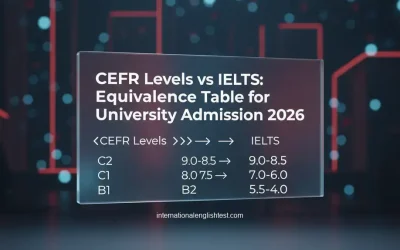
Universities typically cross-reference CEFR, IELTS, and TOEFL scores. Misrepresenting equivalence is as risky as claiming you’re fluent after one week in London—don’t do it. Always use the officially published tables. Here’s a reference for local use:
| Exam | CEFR B2 | CEFR C1 | Notes |
|---|---|---|---|
| IELTS Academic | 5.5 – 6.0 | 7.0 – 8.0 | Accepted by all universities in Taiwan |
| TOEFL iBT | 72 – 94 | 95 – 110 | Official conversion tables used |
| International English Test (IET) | B2 Certification | C1 Certification | Used for direct equivalence |
| Cambridge English | FCE: Pass | CAE: Pass | Widely accepted |
The mistake most applicants make? Submitting out-of-date conversion tables, or mixing General and Academic modules—universities notice. Always use up-to-date references from admissions offices.
Validity Period and Verification of CEFR Certificates for Admissions
In Taiwan, most universities set the validity of B2 and C1 certificates at two years from the test date. It may feel like your certificate should last forever, but think of it like a passport—valid for a set period, then you need a renewal to prove you’re still up to standard.
The process to verify certificates usually means uploading a digital copy or adding a verification code in your application. If the certificate is from a recognized testing body, universities can instantly confirm authenticity online. Some programs may require in-person verification at registration.
- B2 and C1: Valid for admissions up to two years from test date
- Verification: Digital upload plus code, or direct confirmation with testing provider
- Failed verification or expired certificates = rejected application
Today, check your certificate’s expiry date and request a new official transcript if you’re within six months of expiration. Universities often need valid certificates not just at the point of admission, but for course registration and even visa processing. Don’t risk a last-minute rejection—plan ahead.
FAQ
Is a CEFR B2 certificate enough for all universities in Taiwan?
B2 is the minimum for most undergraduate programs, but some faculties or international programs may require C1. Always check your target university’s official requirements.
How long is my CEFR certificate valid for admissions?
Most universities accept certificates dated within two years of the application. Expired certificates are almost never accepted for entry.
How can I verify if my English certificate is recognized?
Check with the university admissions office or use their online verification portal. Official testing providers also offer direct verification services.
Can I use an old IELTS or TOEFL score for new applications?
No. If the score is older than two years, you’ll likely need to retake the test or submit a more recent result. Universities are strict with validity windows.
Are CEFR, IELTS, and TOEFL scores interchangeable for all university programs?
They are usually cross-referenced, but exact equivalence depends on each university’s published conversion policy. Submit the official conversion chart with your application if in doubt.