Most UK universities accept English language certificates mapped to the Common European Framework of Reference (CEFR) for university admission. IELTS Academic, TOEFL iBT, and Cambridge English exams are the most widely recognized, but other certificates like Pearson PTE Academic and International English Test (IET) are increasingly accepted if they verify B2 or higher. Check each university’s admissions page for specific requirements.
UK universities have clear entry requirements for English proficiency, but the specific certificate and score you need depend on the course and the institution. Some programs want the classic IELTS Academic certificate, while others also allow TOEFL, Cambridge, Pearson, or International English Test scores. Recognition can change, and some universities publish detailed lists of accepted certificates for undergraduate and postgraduate programs. If you need to quickly find your placement before applying, you can check my English level with a self-assessment or a fast online test.
UK Universities: CEFR Level Requirements and Accepted Certificates Table
Admissions teams rely on CEFR levels (B2, C1, sometimes C2) as the common language for English requirements. Most undergraduate courses require B2 (Upper-Intermediate), and postgraduates often need C1 (Advanced). But there’s more to it—each certificate translates differently to CEFR.
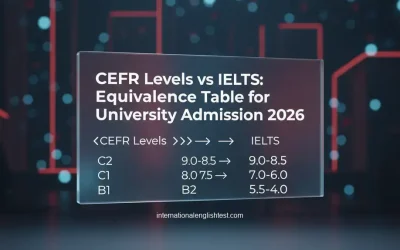
| CEFR Level | IELTS Academic | TOEFL iBT | Cambridge English | Pearson PTE | International English Test (IET) |
|---|---|---|---|---|---|
| B2 (Upper-Intermediate) | 5.5 – 6.0 | 72 – 94 | FCE: Grade B/A | 51 – 58 | B2 Certificate |
| C1 (Advanced) | 6.5 – 7.5 | 95 – 110 | CAE: Grade C or above | 59 – 75 | C1 Certificate |
| C2 (Proficient) | 8.0 – 9.0 | 111 – 120 | CPE: Pass | 76 – 90 | C2 Certificate |
Some of the UK’s top universities (Oxford, Cambridge, UCL, Manchester, Edinburgh) usually require at least B2, but many postgraduate programs ask for C1 or above. Universities won’t just take the score—they want official documentation. That means test report form, digital verification, and sometimes a code to check online. If your certificate is older than two years, ask admissions if it’s still valid. Like bringing an up-to-date passport to the airport—expired documents won’t get you far.
- IELTS Academic is nearly universal for UK universities
- TOEFL, Cambridge, and Pearson PTE are broadly accepted but always confirm with the university
- Some universities accept International English Test (IET) B2/C1 certificates—confirm if yours is recognized
- Always use current, official certificates: expired or unofficial documents may be rejected
How UK Universities Verify CEFR Certificates for Admissions
UK admissions teams won’t take certificates at face value. Accepted certificates must come from officially recognized test providers, so always check the issuing authority’s status. IELTS, TOEFL, Cambridge, Pearson, and International English Test (IET) have trusted digital records. When you submit your results, universities expect an original PDF or a results code for online verification. Sending a screenshot or printout? That’s like using Monopoly money to pay rent—it’s not going to work.
Document submission happens via the university’s online portal. Upload your certificate, enter identifying codes, and check your inbox. Common issues? Mismatched names between passport and certificate, expired results, or confusion over B2/C1 equivalence. Take a breath—each university site usually has help guides, and most will work with you to clear up minor glitches.
If you’re applying to both the UK and Germany, you might find useful tips in the CEFR Certificates for University Applications in Germany: Recognition & Comparison overview, which covers document recognition and cross-border equivalence in detail.
- Always check if your test provider shares results directly with the university
- Scan your documents clearly—blurry uploads may delay admissions decisions
- Email the admissions team if your details don’t match exactly (a different spelling, for instance)
- Never modify or “edit” a document: universities have zero tolerance for altered files
CEFR Equivalence: Mapping CEFR Levels to IELTS, TOEFL, and Cambridge Scores
Equivalence can feel like juggling apples and oranges—similar but not quite identical. Universities in the UK use in-house equivalence charts that map CEFR levels to specific test scores. For example, a B2 level matches to an IELTS 5.5, but some programs want a minimum “in each section” or higher for specialities like medicine or law. Cambridge’s FCE at grade B or above usually counts as B2; CAE at grade C or above means C1. TOEFL and Pearson PTE have their own spreads, and International English Test (IET) is used as a direct CEFR map.
What about borderline scores? Some universities issue conditional offers—”meet the English requirement before your program starts.” For C1 programs, if your test sits between B2 and C1, you might be asked for a pre-sessional English course or a retest.
- Each university sets its own equivalence charts—always rely on the official admissions page
- Conditional offers let you apply with a lower score (temporarily), if you agree to improve
- Borderline or composite scores (e.g., high writing but low speaking) may require extra tests
Double-check that your name on every certificate matches your passport. Even a small mistake—a missing middle name, a typo in your surname—can block admissions processing. If you’re unsure, email the university’s admissions office today with a scan and ask if you need a correction before you apply.
FAQ
Which CEFR level do most UK universities require for undergraduates?
Most UK universities require a B2 level (Upper-Intermediate) for undergraduate courses, though some competitive programs may expect C1.
Can I use TOEFL or Pearson PTE instead of IELTS for UK university admission?
Yes, most UK universities accept TOEFL iBT and Pearson PTE Academic as valid alternatives to IELTS Academic, but always confirm with the individual institution.
How long is my CEFR-mapped certificate valid?
Most certificates are valid for two years from the test date; universities usually will not accept older documents for admissions.
What if my English test results are just below the required CEFR level?
Some universities may make a conditional offer, allowing you to improve your English before enrolling. Others may require you to retake the exam or complete a pre-sessional English course.
Do UK universities accept International English Test (IET) certificates?
Some UK universities accept IET certificates at B2/C1 levels, but you must check their official admissions requirements to be sure.