Most UK universities accept a minimum English level of CEFR B2 for undergraduate study, and B2 or C1 for postgraduate programs. Certain competitive courses, or those involving communication-heavy disciplines, may require C1. Always check the specific program requirements before applying.
Planning ahead saves stress. If you want concrete proof for your application, there’s an easy way to find my CEFR level online in minutes.
CEFR Level Requirements for Undergraduate and Postgraduate Study (with Table)
Entry requirements for British universities aren’t just boxes to tick—they signal your readiness to engage fully in academic life. For international students, English proficiency levels are crucial, since everyday interaction, seminars, and written assignments all demand strong language skills. Undergraduate degrees typically admit students with a minimum of CEFR B2, but postgraduate or research-based degrees often push that bar closer to C1. Law and medicine? These fields may insist on nothing less than C1.
- For most undergraduate programs: CEFR B2 (equivalent to IELTS 5.5–6.0 or TOEFL iBT 72–94)
- Premium postgrad programs: CEFR C1 (IELTS 6.5–7.0 or TOEFL iBT 95–110)
- Foundation or pre-sessional courses may accept B1
Any parent choosing a school wouldn’t let just any builder lay the foundation. The same goes for degree entry: standards matter. Below is a comparison of typical requirements and certificate equivalents.
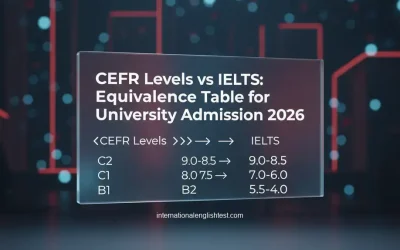
| CEFR Level | IELTS | TOEFL iBT | Accepted For |
|---|---|---|---|
| B1 | 4.0 – 5.0 | 42 – 71 | Foundation / pre-sessional only |
| B2 | 5.5 – 6.0 | 72 – 94 | Most undergraduate degrees |
| C1 | 6.5 – 7.0 | 95 – 110 | Competitive postgrad/ law/ medicine |
| C2 | 7.5+ | 111+ | Rare, doctorates/teaching |
At King’s College London, most bachelor’s degrees require B2 or above. MSc programs there, like many Russell Group universities, often insist on C1. Always confirm for your target subject, though—art history won’t have the same bar as pharmacy.
Which CEFR Certificates Are Officially Recognised by UK Universities?
Universities accept a wide range of official English language certificates mapped to the CEFR. The best-known include Cambridge English Qualifications, such as First (FCE–B2), Advanced (CAE–C1), and Proficiency (CPE–C2). Trinity College London’s ISE II (B2) and ISE III (C1) are also recognised, especially for visa purposes. Other common options: IELTS Academic, TOEFL iBT, and Pearson PTE Academic—each carefully mapped to the CEFR scale.
- Cambridge English Qualifications
- Trinity College London ISE
- IELTS Academic
- TOEFL iBT
- Pearson PTE Academic
- International English Test (IET) – growing university acceptance, so check your university’s list
For authenticity, certificates must match the version and year stated by the university. Submit scanned, legalised documents via the admissions portal. Some universities run spot verifications, so ensure your certificate code is valid and easily verifiable—you wouldn’t hand in fake currency at a bank. If in doubt, contact admissions directly before deadline season kicks in.
How Universities Verify CEFR Certificates for International Applications
The verification process for CEFR certificates isn’t guesswork. It’s a multi-stage filter. First, universities validate your document against official exam provider registries. Some ask for original copies at registration day or arrival. If there’s any doubt—mismatched names, unclear scan, or suspicious history—they’ll push back and request further proof, possibly a short interview in English.
Facing a certificate rejection? You have a right to appeal. But it comes down to proof: was your certificate authentic, issued on the date you claimed, and matched with the rest of your details? Like applying for a driving licence, even one missing detail can stall your whole journey. If concerns arise about fairness or process, most schools offer a formal complaint route, but acting quickly is crucial.
If you’re not sure whether your exam will be accepted for a specific UK program, take five minutes to read Pre-Employment Test: Must-Know Essentials for Career Success. Even for university entry, the checks and certificates explained there will make your next steps far smoother.
If your test is due soon, run a timed practice under real exam conditions—use the window light and background noise you’ll have on test day. This builds comfort, stops panic, and puts you one notch ahead of applicants who only rehearse in silence.
FAQ
What CEFR level do I need for a UK bachelor’s degree?
B2 is typically the minimum, but some programs prefer C1—always check for exceptions in medicine or law.
Are IELTS and TOEFL both mapped to CEFR?
Yes, both exams publish official conversion charts so you can match your score to CEFR levels easily.
Can I submit an online English test for admission?
Many universities accept online formats, but the exam must be listed in their official requirements—ask admissions directly.
What’s the most common reason CEFR certificates are rejected?
Invalid, expired, or unverifiable certificates—usually due to outdated formats or incomplete documentation.
How soon do I need to submit my CEFR proof?
Submit as soon as possible after results, but always before the university’s stated application or visa deadline.