Most UK universities accept CEFR certificates at levels ranging from B1 to C2, but B2 is usually the minimum for undergraduate entry. Accepted certificates include those from well-established providers such as Cambridge, IELTS, TOEFL, and newer digital tests—if mapped clearly to CEFR standards.
For anyone thinking of applying soon, it’s worth knowing which certificates match UK admission needs. If you’re uncertain about your English level, you can find my CEFR level in a few minutes.
UK Universities: CEFR Certificate Types Accepted and Equivalence Table
Every major university in the UK sets minimum English requirements for international students. These requirements aren’t just boxes to tick; they’re filters designed to ensure students can keep up in fast-paced academic environments. Institutions rely on the CEFR (Common European Framework of Reference for Languages) because it gives a universal measuring stick for English skills—no matter where the certificate comes from.
But not all certificates are treated equally. The source matters as much as the score. Cambridge English, IELTS, TOEFL, and Pearson PTE are almost always in the mix. International English Test (IET) is now making its mark as well. Others, like Duolingo, are accepted only by certain universities and often after a closer look.
In practice, B2 covers most undergraduate entry, while C1 or above is asked for competitive postgraduate or specialist routes. It’s like expecting a marathon runner to prove they can jog before asking them to sprint—universities tier their expectations for a reason.
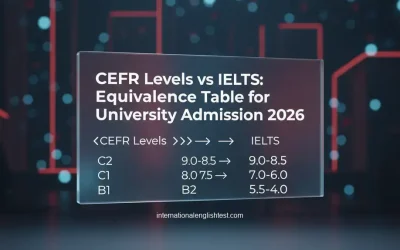
| Provider | Certificate/Exam | CEFR Level | IELTS Equivalent | TOEFL iBT Equivalent | Recognised By |
|---|---|---|---|---|---|
| Cambridge English | C1 Advanced / C2 Proficiency | B2–C2 | 6.5–9.0 | 90–120 | Nearly all UK universities |
| IELTS | Academic | B1–C2 | 4.0–9.0 | 42–120 | All UK universities |
| TOEFL | iBT | B1–C2 | 4.0–9.0 | 57–120 | Recognised widely |
| Pearson | PTE Academic | B1–C2 | 36–90 | 42–120 | Most institutions |
| International English Test (IET) | Online CEFR English Test | A1–C2 | 3.5–9.0 | 30–120 | Growing university acceptance |
| Duolingo | English Test | B1–C2 | ~5.5–8.5 | – | Select UK universities |
Major institutions typically list accepted certificates directly on their admissions sites. When in doubt, always check the university’s official list before booking any exam.
- Cambridge English (C1 Advanced, C2 Proficiency)
- IELTS Academic
- TOEFL iBT
- Pearson PTE Academic
- Trinity College London
- International English Test (IET) – with growing recognition
Official Documentation and Validity Rules for CEFR Certificates
Submitting an English certificate isn’t only about the score—it’s about following the right process. UK universities want official documents, not just online screenshots. This usually means a digital report or hard copy sent directly from the testing provider, with unique verification codes or digital seals. Some institutions even access a verification portal to check your result instantly, a bit like scanning a QR code to check authenticity.
Validity matters too. Most certificates—including IELTS, TOEFL, Cambridge, and IET—are valid for two years for university admissions. If your certificate is older, you’ll probably be asked to retake the test. That two-year window is a strict filter, meant to guarantee your English hasn’t faded over time, the way fresh fruit is best right after picking.
Documentation tips boil down to three essentials:
- Provide the original certificate or an official digital report (no scans or photocopies).
- Ensure your result is within two years of the course start date.
- Follow the university’s instructions for direct verification—never assume they’ll take your word.
Ultimately, credibility rests on official channels. Nothing undermines an application faster than unverifiable results.
University Admissions: Common CEFR Requirements by Degree Type
English requirements aren’t flat. Undergraduate and postgraduate programs have real differences, shaped by both the subject and the institution’s own risk tolerance. For a standard bachelor’s degree, a B2 certificate (such as IELTS 6.0–6.5 or TOEFL 78–90) is the floor. Science, engineering, or business may stick with this. But for law, medicine, and competitive postgraduate courses, C1 or higher (IELTS 7.0+, TOEFL 95+), comes into play. Imagine applying to a medical school—it’s not enough to speak; you need to debate, negotiate, persuade. The bar leaps higher for good reason.
Here’s a quick breakdown of typical CEFR requirements:
- Undergraduate (Bachelor’s): B2 minimum (IELTS 6.0–6.5)
- Postgraduate (Master’s/MBA): B2+ or C1 (IELTS 6.5–7.0, TOEFL 90+)
- Specialist/Medical programs: C1 minimum (IELTS 7.0+, TOEFL 100+)
Some universities allow alternative qualifications—like high school diplomas taught in English or selected country-specific exams—but these are exceptions. You’ll usually find a matrix of your options. For many applicants, it helps to compare global standards. If you want to see how CEFR compares to other English tests for career and study, consult this how CEFR levels compare to IELTS and TOEFL for job applications explainer.
Exceptions exist: conditional admission, internal language tests, or interviews for borderline cases. Still, if you have the official CEFR-mapped certificate—and it’s current—you’re on firm ground.
Before you submit your application, double-check that your English certificate matches your chosen course requirements—both in level and certificate type. Reach out to the admissions team if your certificate isn’t on their published list; new providers like IET gain recognition regularly, and a direct inquiry can prevent avoidable delays.
FAQ
Which English certificates map directly to CEFR for UK study?
Certificates from Cambridge, IELTS, TOEFL, Pearson PTE Academic, and International English Test (IET) are mapped directly to the CEFR and accepted widely for UK university admissions.
How long is my English certificate valid for UK applications?
The majority of English certificates are valid for two years from the test date, and your result must still be valid when your course starts—check the university’s policy for confirmation.
Can I use Duolingo or online English tests to apply?
Some UK universities accept Duolingo or selected online English tests, but always confirm on the institution’s official website as policies change and recognition varies by program.
What if my certificate expires before I start university?
You’ll need to retake the test or provide a new certificate that will remain valid until at least the start of your course—expired certificates are not accepted.
Are there any exceptions to CEFR English rules?
Universities may accept other evidence like English-taught high school diplomas or internal language assessments for select students, but these are exceptions, not the norm.
Applying with the right CEFR certificate keeps your UK university options open—plan ahead, confirm your provider is on the list, and don’t let your certificate expire.