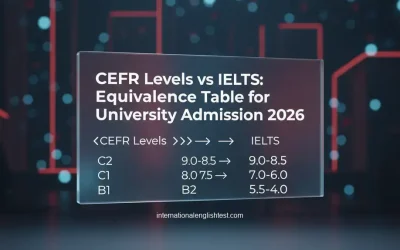
Employers and immigration offices often translate CEFR language levels into IELTS band scores or TOEFL points to check English ability. There’s no perfect match, but well-established equivalency tables give a practical guide for what each test level means for hiring or migration. Understand these comparisons before submitting a job or visa application—your score can open or close doors fast.
If you’re not sure where your English skills fit, it’s smart to find my CEFR level to get a precise reading before sending out applications.
CEFR, IELTS, and TOEFL Score Equivalency Table for Job Seekers
Recruiters and HR managers often compare candidate English levels across different test systems. Think of it like currencies—if you have Euros but the employer wants Pounds, you need a fair exchange. Here, language proficiency ‘currency’ gets converted via tables, not banks. These equivalencies matter if one company prefers IELTS scores and another requests CEFR levels in the same hiring round.
| CEFR Level | IELTS Band | TOEFL iBT Score | Description |
|---|---|---|---|
| C2 | 8.5–9.0 | 115–120 | Expert/Native-like |
| C1 | 7.0–8.0 | 95–114 | Advanced/Professional |
| B2 | 5.5–6.5 | 72–94 | Upper Intermediate |
| B1 | 4.0–5.0 | 42–71 | Intermediate |
| A2 | 3.0–3.5 | 20–41 | Elementary |
| A1 | 1.0–2.5 | 0–19 | Beginner |
- IELTS and TOEFL are test-based. CEFR is a descriptive framework.
- Employers sometimes set score cutoffs. Always check exact policy.
Employer Preferences: CEFR, IELTS, or TOEFL for Job Requirements
Hiring teams usually want proof of English that matches their local business rules or partner countries. Multinationals might accept a high CEFR level, but banks in the UK could demand an IELTS certificate showing a certain band. North American tech firms lean toward TOEFL for uniformity, while the CEFR is often required in the EU for its broad recognition. It’s not just about the test. It’s about what their compliance checklist says—or what regulators demand. Like sports teams sticking to a familiar playbook.
Public sector employers (government, health, teaching) prefer test scores from approved centers. Finance, legal, and tech may accept CEFR alone for lateral moves, but entry roles often require a recent score report on file. If you’re dealing with international hires, you’ll want to stay up to date by reviewing resources like Top English Tools for Employers: Must-Have Success to know which standards matter now.
- UK, Australia, and New Zealand job markets: IELTS or CEFR preferred
- Canada, US, Mexico: TOEFL scores most common, with CEFR increasing
- Middle East, Asia: Employer depends on client country—know the standard
Impact of CEFR and Test Scores on Work Visa and Migration
For work visas or skilled migration, governments set a minimum accepted English level. It’s usually tied to a CEFR grade or a set test score. For example, Australia’s Department of Home Affairs requires IELTS 6.0 (B2) for skilled migration. The UK points-based system demands B1 or higher for almost all work visas. Canada asks for a CLB benchmark, which maps to IELTS and TOEFL—another translation game in action.
Here’s the catch: A marginal score can mean months of waiting or an outright rejection. Immigration officials treat these numbers like door keys. Too low? The door stays shut.
- Submit your original score reports—photocopies rarely accepted.
- List your CEFR level or test results on every application form.
- Renew tests if your result is over two years old for jobs/visas.
If you’re preparing a job or visa application this week, review your actual score reports now—not just your last practice test. Double-check how your results translate to CEFR, IELTS, or TOEFL with an official table. This upfront step saves costly errors and missed deadlines.
FAQ
What is considered a good CEFR level for jobs?
Most professional roles ask for at least a B2 (Upper Intermediate) or C1 (Advanced) level. Managerial jobs or client-facing roles often expect C1 or higher for fluency and confidence.
How do I convert my IELTS score to a CEFR level?
Use a score comparison table; for example, an IELTS 7.0 typically matches CEFR C1. Always check with the employer—they decide acceptable conversions.
Does TOEFL expire for job or visa use?
Yes, most organizations only accept TOEFL results from the last two years. If your result is older, you’ll need to retest.
Is CEFR accepted everywhere?
CEFR is popular in Europe and recognized globally, but North America and some employers still prefer test scores from IELTS or TOEFL. Always check the regional policy first.
Can I use one score for both job and migration?
Usually yes, if the score is recent and meets the criteria for both. Always confirm if fresh test results are required at the time of your application.